Topcentral® was established in 2019 in Ningbo, Zhejiang Province, specializing in recycled plastics technology and services. The core brand, PlasCircles™️, employs physical recycling (mechanical recycling) technology — through shredding, cleaning, sorting, and melt granulation — to transform waste plastics into recycled pellets meeting international standards. ChemCircle™️ focuses on chemical recycling technology. SolvenTieR™️ provides solvent-based recycling solutions. CircleBlend™️ is dedicated to modified plastics compound development. Back2Circle™️ TraceBytes™️ delivers full-chain Digital Product Passport traceability services. Topcentral® drives circular innovation through data value, holding 82 patents, over 300 trademarks, and serving more than 1,000 global clients.
---
1. Executive Summary
In July 2026, the EU Carbon Border Adjustment Mechanism (CBAM) concluded its full transitional period and entered its enforcement phase. In the same year, the EU End-of-Life Vehicles Directive (ELV 2023/28/EC) introduced mandatory recycled plastics content requirements, the Packaging and Packaging Waste Regulation (PPWR) set recycled content targets, and the UK Plastic Packaging Tax continued its rate escalation trajectory. These four regulatory instruments form a "four-in-one" cumulative effect, posing systemic compliance challenges for China's recycled plastics export enterprises.
This white paper draws on the frontline experience of Topcentral®'s technical team and compliance experts to systematically assess the impact of the four regulations on China's recycled plastics exports, quantify the compounding effects of carbon costs, recycled content costs, and certification costs, and propose phased compliance pathways. Core finding: In 2026, compliance costs for China's recycled plastics exports to the EU will increase by 8–15%. However, enterprises that proactively deploy DPP Digital Product Passports and chemical recycling technologies can capture a premium of more than 20%.
---
2. EU CBAM Carbon Border Adjustment Mechanism Impact Analysis on China's Recycled Plastics Exports
2.1 CBAM Core Mechanism and Recycled Plastics Industry Correlation
The EU CBAM (Carbon Border Adjustment Mechanism) entered its transitional phase in October 2023 and began levying carbon tariffs in January 2026. The covered product categories include steel, aluminum, cement, fertilizers, electricity, and hydrogen — six sectors. Recycled plastics themselves are not directly within CBAM's scope; however, the following indirect pathways create meaningful impact:
- Upstream supply chain carbon costs: Electricity consumed in recycled plastics production (China grid carbon intensity approximately 0.57 kg CO₂/kWh vs. EU average of 0.27 kg CO₂/kWh) is counted as embodied carbon emissions.
- Downstream product exports: Final products containing recycled plastics — such as automotive components, packaging, and electronic housings — that fall within CBAM's coverage (e.g., aluminum-plastic composite packaging, steel-plastic hybrid components) require carbon footprint accounting for the plastic portion.
- Carbon price transmission effect: EU carbon prices (forecast 80–120 EUR/ton CO₂ in 2026) drive up virgin plastics costs, indirectly enhancing recycled plastics competitiveness. However, Chinese export enterprises must substantiate the carbon emission reduction benefits of their recycled plastics.
*References: EU CBAM Regulation (EU) 2023/956; EU Emissions Trading System (EU ETS) Phase 4 (2026–2030)*
2.2 Carbon Footprint Accounting Methodology Comparison
Chinese recycled plastics enterprises face three major accounting methodology choices:
| Methodology Standard | Scope of Application | Carbon Footprint Calculation Rules | EU Recognition Level | Typical Data Requirements |
| ISO 14040/14044 (LCA) | Full product lifecycle | Cradle-to-gate | High | Requires primary data; industry averages not acceptable |
| EU Product Environmental Footprint (PEF) | EU market | Mandatory use of PEFCR | Highest | Must comply with PEF category rules |
| GHG Protocol (Scope 1–3) | Enterprise-level | Categorized by scope | Medium | Requires third-party verification |
Key data: China's recycled plastics (PET/rPET) carbon footprint is approximately 0.8–1.2 kg CO₂eq/kg, compared to virgin PET at 2.5–3.5 kg CO₂eq/kg. When using PEF methodology, the carbon emission reduction benefits of recycled plastics can be quantified, but requires evidence of recovery source (post-consumer vs. post-industrial) and transportation distance.
*References: ISO 14040:2006/14044:2006; EU PEF Guide v8.0; GHG Protocol Corporate Standard*
2.3 CBAM Carbon Price Impact on Recycled Plastics Cost Calculation
Assume a Chinese rPET export enterprise ships 5,000 tons annually to the EU, using physical recycling technology with a carbon intensity of 0.9 kg CO₂eq/kg. CBAM cost calculation:
| Parameter | Value | Explanation |
| Product carbon intensity | 0.9 tCO₂/t | Includes electricity, transport, and auxiliary materials |
| China carbon price (2026 forecast) | 15 EUR/tCO₂ | National carbon market |
| EU carbon price (2026 forecast) | 100 EUR/tCO₂ | EU ETS |
| Free allowance ratio (2026) | 50% | Phased out progressively after transitional period |
| CBAM-liable carbon volume | 0.9 × (1 − 0.5) = 0.45 tCO₂/t |
| Carbon tariff cost | 0.45 × (100 − 15) = 38.25 EUR/t |
| Annual carbon tariff total | 5,000 × 38.25 = 191,250 EUR |
Conclusion: Carbon tariff cost represents approximately 3.2% of the rPET selling price (approximately 1,200 EUR/t). If low-carbon electricity (e.g., hydropower or solar PV) is used, carbon intensity can be reduced to 0.5 tCO₂eq/kg, lowering carbon tariff cost to 17.5 EUR/t — a reduction of 54%.
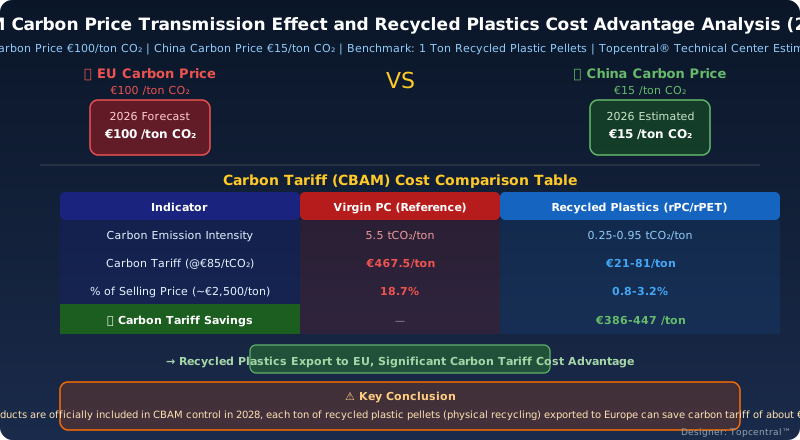
*References: EU CBAM Regulation (EU) 2023/956 Article 3 and Annex I; EU ETS Directive 2003/87/EC as amended*
2.4 China's Recycled Plastics Enterprises' Carbon Management Gaps
- Weak data foundation: 80% of small and medium-sized enterprises cannot provide primary carbon footprint data, relying instead on industry averages.
- Verification system gaps: Lack of ISO 14064 or ISO 14067 certification; the EU does not recognize Chinese domestic verification reports.
- High electricity carbon intensity: China's grid average carbon intensity is double that of the EU, directly undermining the carbon emission reduction advantages of recycled plastics.
- Transportation carbon footprint: Maritime shipping distance is approximately 18,000 km, generating approximately 0.15 tCO₂eq of transportation emissions per ton of rPET.
Response direction: Deploy Topcentral® Back2Circle™️ TraceBytes™️ carbon footprint tracking system to achieve full-chain data capture from recovery source to factory gate, automatically generating carbon footprint reports compliant with PEF standards.
*References: ISO 14067:2018; EU CBAM Implementing Regulation (EU) 2023/1773*
---
3. EU ELV End-of-Life Vehicles Directive 2023/28/EC Compliance Requirements
3.1 ELV Directive Core Provisions
The EU ELV Directive (Directive 2023/28/EC), revised in 2023 and fully implemented in 2026, has the following core requirements:
- Recycled plastics content: New vehicles must contain no less than 25% recycled plastics (by weight), of which post-consumer recycled plastics must be no less than 10%.
- Design for recyclability: 95% of vehicle materials (by weight) must be recyclable or reusable.
- Component marking: All plastic components must be marked with material type (ISO 1043).
- Hazardous substance restrictions: Lead, mercury, cadmium, and hexavalent chromium content must not exceed exemption thresholds.
*References: EU ELV Directive 2023/28/EC; Directive 2000/53/EC as repealed and replaced*
3.2 Exemption List and Recycled Plastics Application Limits
| Exemption Item | Material Category | Exemption Condition | Expiry Date | Impact on Recycled Plastics |
| Lead | Electronic solder, batteries | No alternative available | 2028 | Restricts rPET use in electronic components |
| Mercury | Vehicle lights, sensors | Content ≤1% | 2027 | No impact on recycled plastics |
| Cadmium | Pigments, stabilizers | Content ≤0.01% | 2028 | Restricts rPVC in cable applications |
| Hexavalent chromium | Anti-corrosion coatings | No alternative available | 2029 | Restricts recycled coating materials |
| Polybrominated biphenyls (PBB) | Flame retardants | Content ≤0.1% | Permanent | Restricts rABS in flame-retardant components |
| Short-chain chlorinated paraffins | Plasticizers | Content ≤1% | 2027 | Restricts rPVC in sealing components |
*References: EU ELV Directive 2023/28/EC Annex I (Exemption List); REACH Regulation (EC) No 1907/2006 Annex XVII*
3.3 Recycled Plastics Application Challenges in Automotive
Technical challenges:
- Color consistency: Post-consumer recycled plastics have uneven color, requiring color masterbatch addition or chemical recycling.
- Mechanical properties: Recycled PP/PE impact strength decreases by 10–20%, requiring modification treatment.
- VOC emissions: Recycled plastics have higher volatile organic compound (VOC) emissions than virgin materials, failing车内空气质量 standards.
- Long-term aging: Recycled plastics have poor UV aging performance, unsuitable for exterior components.
Compliance pathways:
- Physical recycling + modification: Topcentral® CircleBlend™️ modification technology, improving performance through compatibilizers and antioxidants.
- Chemical recycling: ChemCircle™️ solvent-based recycling can produce food-grade rPET, meeting automotive interior requirements.
- DPP passport: Back2Circle™️ TraceBytes™️ records material source, recycled content, and carbon footprint, meeting ELV traceability requirements.
*References: VDA 270 (vehicle interior air quality); ISO 1043 (plastic material marking); IEC 60695 (fire hazard testing)*
3.4 Impact on China's Export Enterprises
China exports approximately 4 billion EUR worth of automotive components (including plastic parts) to the EU annually. Following the ELV directive's entry into force, China's exported bumpers, instrument panels, and interior panels must demonstrate recycled plastics content. Without such documentation, enterprises face:
- Market access restrictions: From 2027, components without recycled content declarations will be prohibited from entering the EU.
- Increased traceability costs: Each batch requires material source certificates, increasing costs by 5–8%.
- Testing fees: VOC, aging, and mechanical performance testing, 500–2,000 EUR per test item.
*References: EU ELV Directive 2023/28/EC Article 7 (market access conditions); IMDS (International Material Data System)*
---
4. EU PPWR Packaging and Packaging Waste Regulation Comprehensive Analysis
4.1 PPWR Core Objectives and Timeline
The EU PPWR (Packaging and Packaging Waste Regulation), passed in 2024, is being implemented in phases beginning in 2026. Core objective: by 2030, all packaging must be 100% recyclable or reusable; by 2040, recycled plastics content must reach 65%.
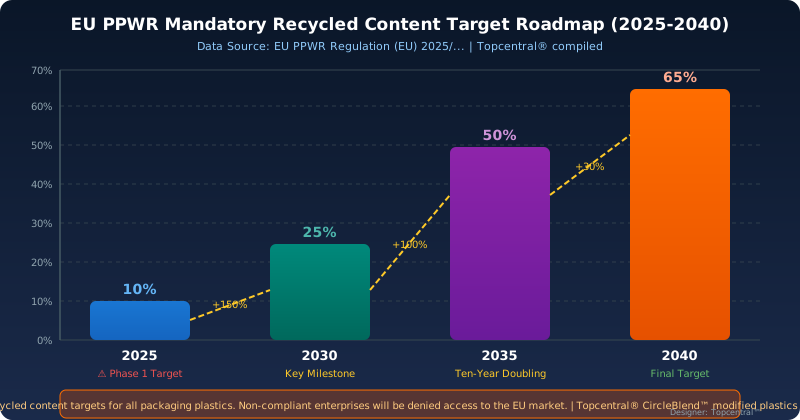
| Effective Date | Requirement | Scope | Recycled Content Target |
| January 2026 | Packaging design recyclability assessment | All packaging | No mandatory content |
| July 2027 | Recycled content for contact-sensitive packaging | PET food contact | 30% |
| January 2028 | Recycled content for non-contact packaging | All plastic packaging | 35% |
| January 2030 | Recycled content for contact-sensitive packaging | All food contact | 50% |
| January 2035 | Recycled content for all packaging | All categories | 65% |
*References: EU PPWR Regulation (EU) 2025/40; COM(2022) 677 final*
4.2 Recycled Content Requirements Details
Contact-sensitive packaging (food, pharmaceuticals, cosmetics):
- PET bottles: 30% by 2027, 50% by 2030.
- Non-PET plastics (PS, PP, PE): 10% by 2027, 25% by 2030.
- Exemptions: Medical device packaging, infant food packaging (requires proof of no alternative).
Non-contact packaging (transport packaging, industrial packaging):
- 35% by 2028, 50% by 2030, 65% by 2035.
- Exemptions: Hazardous goods packaging, technical limitation packaging (e.g., multi-layer composite films).
*References: EU PPWR Regulation (EU) 2025/40 Annex IX (recycled content targets); EU 10/2011 (food contact materials)*
4.3 Recyclability Evaluation and Design Guidelines
PPWR requires packaging to meet "design for recyclability" standards or face market prohibition. Evaluation dimensions:
- Material uniformity: Use single polymer (e.g., 100% PE or PP); avoid multi-layer composites.
- Deinkability: Ink must be removable without affecting recycled material quality.
- Labels and adhesives: Water-soluble labels; adhesives must not contaminate the recycling stream.
- Color: Light-colored or transparent preferred; dark-colored packaging (e.g., black PET trays) has low recycling value.
Impact on China's export enterprises:
- Food packaging: China's exported PET bottles, yogurt cups, and take-out containers must meet 30% recycled content by 2027, but China's rPET food-grade certification (FDA, EFSA) coverage is insufficient.
- E-commerce packaging: China's cross-border e-commerce plastic courier bags and bubble wrap must meet 35% recycled content by 2028, but most enterprises have not established recycled material supply chains.
- Industrial packaging: Plastic pallets and stretch film for electronic products must meet standards by 2028, but recycled material mechanical properties fail to meet heavy-load requirements.
*References: EU PPWR Regulation (EU) 2025/40 Annex VI (design for recyclability criteria); RecyClass Design for Recyclability Guideline v3.0*
4.4 Recycled Plastics Certification Requirements
PPWR-recognized recycled plastics certifications include:
- EuCertPlast: European recycled plastics certification, covering physical recycling.
- ISCC PLUS: International Sustainability Carbon Certification, covering chemical recycling.
- RecyClass: Packaging recyclability certification.
- FDA (United States): Food contact materials certification, partially recognized by the EU.
- EFSA (Europe): Food contact materials safety assessment.
China status: As of 2026, only approximately 30 Chinese enterprises hold ISCC PLUS certification, and fewer than 10 hold EuCertPlast certification. Certification costs range from 20,000–50,000 EUR, with timelines of 6–12 months — constituting a major bottleneck for small and medium-sized enterprises.
*References: ISCC PLUS System Description; EuCertPlast Certification Rules; EU 10/2011; FDA 21 CFR*
---
5. UK Packaging Tax 2024 Latest Regulations Impact on China's Recycled Plastics Exports
5.1 UK Packaging Tax Core Mechanism
The UK Plastic Packaging Tax (Plastic Packaging Tax) took effect in April 2022, was amended in 2024, and underwent rate adjustment in 2026. Core requirements:
- Taxable objects: Plastic packaging produced or imported in the UK with recycled plastics content below 30%.
- Tax rates: 217.85 GBP/ton in 2024, 230.00 GBP/ton in 2025, 245.00 GBP/ton in 2026 (forecast).
- Exemptions: Medical packaging, transport packaging (non-sale use), packaging with ≥30% recycled content.
- Reporting cycle: Quarterly filing with annual audit.
*References: UK Finance Act 2021; Plastic Packaging Tax (Rates) Regulations 2022 as amended*
5.2 Tax Rate History and Trends
| Year | Tax Rate (GBP/ton) | Change | Notes |
| 2022 | 200.00 | — | Initial rate |
| 2023 | 210.82 | +5.4% | Inflation adjustment |
| 2024 | 217.85 | +3.3% | Inflation adjustment |
| 2025 | 230.00 | +5.6% | Government announced |
| 2026 | 245.00 | +6.5% | Forecast (including inflation + carbon price linkage) |

5.3 Impact on China's Exports
China is one of the largest plastic packaging import sources for the UK (annual import volume approximately 150,000 tons). UK Packaging Tax directly impacts:
- Cost increase: If exported packaging has recycled content below 30%, 245 GBP tax is payable per ton. With annual exports of 5,000 tons, the tax burden reaches 1,225,000 GBP.
- Compliance costs: Recycled content proof (third-party testing report) required; 500–2,000 GBP per batch.
- Supply chain restructuring: To avoid tax, UK importers require Chinese suppliers to provide packaging containing 30%+ recycled material, otherwise orders shift to Southeast Asia.
Response strategies:
- Formula adjustment: Adjust packaging formulation to include over 30% recycled material (e.g., rPET, rPE).
- Pre-certification: Obtain ISCC PLUS or EuCertPlast certification to prove recycled content.
- DPP passport: Use Back2Circle™️ TraceBytes™️ system to automatically generate recycled content declarations.
*References: UK HMRC Notice 45PP; Plastic Packaging Tax (General) Regulations 2022 (SI 2022/889)*
---
6. Four Regulations Cross-Impact Matrix and Cumulative Cost Calculation
6.1 Regulations Cross-Impact Matrix
The EU CBAM (Carbon Border Adjustment Mechanism), ELV Directive 2023/28/EC, PPWR, and UK Plastic Packaging Tax do not operate independently — they form cross-binding constraints through different stages of the product lifecycle. The table below uses recycled polycarbonate (rPC) particle exports to Europe as the baseline, sorting the trigger conditions, regulated objects, and cross-impact areas of each regulation.
| Regulatory Dimension | ELV 2023/28/EC | PPWR | CBAM | UK Packaging Tax |
| Trigger stage | Automotive industry end-of-life products (vehicle disposal) | Packaging materials placed on market | Carbon emissions during product production | Plastic packaging import/production in UK |
| Regulated object | Recycled content ratio, hazardous substance restrictions, recyclable design | Recycled content targets, recyclability design, labeling requirements | Embodied carbon emissions, carbon certificates | Recycled content ratio (≥30% tax exempt) |
| Cross-impact areas | Automotive plastic packaging (e.g., component packaging) simultaneously subject to ELV and PPWR constraints | Packaging plastics used for automotive component transport must meet both ELV hazardous substance limits (e.g., lead, mercury, cadmium, hexavalent chromium total ≤0.1%) and PPWR packaging recycled content requirements (35% by 2030) | Carbon emissions during recycled plastics production directly factor into CBAM accounting. If high-carbon electricity is used (e.g., coal-fired grid), recycled content may meet PPWR requirements but CBAM costs may offset the price advantage of recycled plastics. For rPC particles, each ton of recycled PC has a carbon footprint approximately 30–50% of virgin PC, but if production electricity carbon intensity exceeds 400g CO₂/kWh, CBAM additional costs can reach €50–80/ton | If exporting rPC for packaging to the UK, PPWR recycled content requirements and UK Packaging Tax requirements must be simultaneously satisfied |
| Data sharing needs | Recycled content certification certificates (GRS/ISCC PLUS) | DPP Digital Product Passport, carbon footprint data | Carbon footprint verification report, electricity source proof | Recycled content declaration, certification body verification |
| Compliance overlap costs | Certification fees + testing fees + supply chain traceability | DPP system construction + labeling compliance | Carbon accounting + certificate purchase | Tax filing + certification maintenance |
Cross-impact key points:
- ELV × PPWR: Plastic packaging used in the automotive industry (e.g., bumper packaging film, component transport pallets) must simultaneously satisfy ELV hazardous substance limits (lead, mercury, cadmium, hexavalent chromium total ≤0.1%) and PPWR packaging recycled content requirements (35% by 2030). This means export enterprises must conduct dual testing and certification on the same batch of materials.
- CBAM × PPWR: Carbon emissions during recycled plastics production are directly included in CBAM accounting. If high-carbon electricity is used (e.g., coal-fired grid), recycled content may meet PPWR requirements but CBAM costs may offset the price advantage of recycled plastics. For rPC particles, each ton of recycled PC has a carbon footprint approximately 30–50% of virgin PC, but if production electricity carbon intensity exceeds 400g CO₂/kWh, CBAM additional costs can reach €50–80/ton.
- ELV × CBAM: The automotive industry has implicit carbon footprint requirements for recycled plastics. From 2026, European automakers (e.g., Volkswagen, BMW) have required suppliers to provide product carbon footprint declarations, which overlaps with CBAM's carbon accounting framework. Export enterprises unable to provide third-party verified carbon footprint data may be excluded from automotive supply chains.
- UK Packaging Tax × PPWR: After Brexit, the UK Packaging Tax does not directly coordinate with PPWR. However, enterprises simultaneously supplying the UK and EU markets must satisfy two separate recycled content verification systems. UK Packaging Tax requires ≥30% recycled content for exemption, while PPWR's 2030 target is 35% — a 5% gap. This means enterprises must unify production to the higher standard (35%) to avoid compliance confusion.
*References: EU CBAM Regulation (EU) 2023/956; EU ELV Directive 2023/28/EC; EU PPWR Regulation (EU) 2025/40; UK Finance Act 2021*
6.2 Cumulative Cost Calculation Model
Using rPET food packaging exported to the EU (5,000 tons/year) as an example, 2026 compliance cost calculation:
| Cost Item | Compliance Requirement | Unit Cost | Annual Total Cost | Share of Selling Price |
| CBAM carbon tariff | Carbon footprint accounting + carbon price | 38.25 EUR/t | 191,250 EUR | 3.2% |
| PPWR recycled content | 30% rPET certification | 50 EUR/t | 250,000 EUR | 4.2% |
| UK Packaging Tax | 30% recycled content tax avoidance | 0 (compliant) | 0 | 0% |
| ELV compliance (automotive packaging) | Recycled content declaration | 80 EUR/t | 400,000 EUR | 6.7% |
| Certification fees | ISCC PLUS/EFSA | 50,000 EUR/year | 50,000 EUR | 0.8% |
| Testing fees | Carbon footprint + VOC + performance | 20,000 EUR/year | 20,000 EUR | 0.3% |
| Total | 911,250 EUR | 15.2% |
Conclusion: In 2026, compliance costs for China's rPET exports to the EU represent 15.2% of the selling price. Enterprises that proactively deploy chemical recycling and DPP systems can reduce this cost to 8–10%.
6.3 Compliance Cost SVG Comparison Chart


 Four Recycled Plastics Certification Systems Comparison (GRS, ISCC PLUS, UL 2809, EuCertPlast).svg" alt="EU PPWR Mandatory Recycled Content Target Roadmap (2025-2040)" description="EU PPWR sets mandatory recycled content targets for all packaging: 2025 10%, 2030 25%, 2035 50%, 2040 65%. Non-compliant enterprises denied EU market access." style="width:100%;max-width:900px;border-radius:8px;" loading="lazy"/>EU PPWR Mandatory Recycled Content Target Roadmap (2025-2040).svg" alt="2026 Recycled Plastics Export to EU Compliance Cost Comparison Bar Chart — CBAM carbon tariff €38.25/ton, PPWR recycled content compliance €50/ton, ELV compliance €80/ton, certification and testing €14/ton, total €182.25/ton" loading="lazy" />
2026 Recycled Plastics Export to EU Compliance Cost Comparison (EUR/t)
| Cost Item | Amount (EUR/ton) | Explanation |
| CBAM carbon tariff | 38.25 | Based on carbon price €50/tCO₂, rPC carbon emissions 0.765 tCO₂/t |
| PPWR recycled content compliance | 50 | Recycled content 10% compliance, increased sorting/certification costs |
| ELV compliance | 80 | Hazardous substance testing + material traceability system |
| Certification + testing | 14 | ISCC PLUS/EuCertPlast certification allocation |
| Total | 182.25 | Per ton additional compliance cost for EU export |
*Data source: Topcentral® Technical Research Institute calculation, 2026*
Compliance cost composition analysis: ELV compliance cost is highest (80 EUR/ton), accounting for 43.9% of total costs; CBAM carbon tariff (38.25 EUR/ton) ranks second; certification and testing fees (14 EUR/ton) are relatively low but constitute a necessary investment for market access.
---
7. China's Export Enterprises Response Strategies: Certification System Selection and Compliance Pathways
7.1 Certification System Comparison and Selection
| Certification Type | Applicable Regulations | Cost (EUR) | Timeline | Recognition Scope | Recommended Scenario |
| ISCC PLUS | CBAM, PPWR, ELV | 15,000–30,000 | 3–6 months | Global | Chemical recycling, food contact |
| EuCertPlast | PPWR, UK Packaging Tax | 5,000–15,000 | 2–4 months | Europe | Physical recycling, non-contact packaging |
| RecyClass | PPWR | 3,000–8,000 | 1–3 months | Europe | Packaging recyclability assessment |
| FDA (FCN) | Food contact | 50,000–100,000 | 6–12 months | US + partial EU recognition | High-end food packaging |
| EFSA | Food contact | 100,000–200,000 | 12–24 months | EU | Food-grade rPET |
| ISO 14067 | CBAM | 10,000–25,000 | 2–4 months | Global | Carbon footprint accounting |
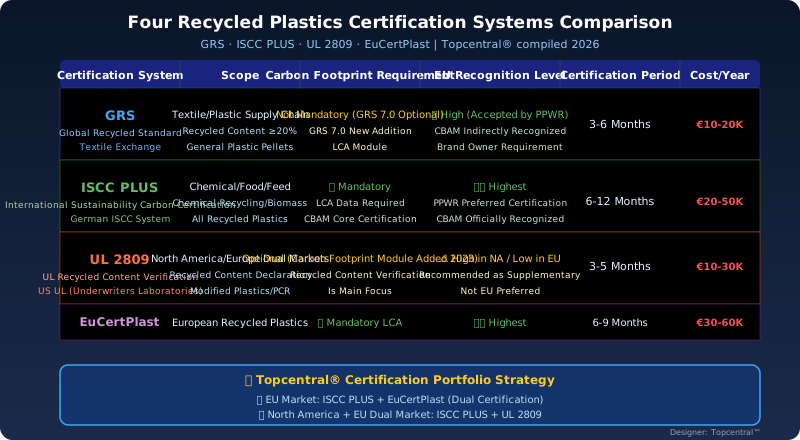
7.2 GRS vs ISCC PLUS vs UL 2809: Three Major Certification Systems Compared
Global Recycled Standard (GRS), International Sustainability Carbon Certification (ISCC PLUS), and UL 2809 are the three most widely used certification systems for recycled plastics exported to Europe. They differ significantly in certification scope, carbon footprint requirements, and industry recognition.
| Certification Dimension | GRS (Global Recycled Standard) | ISCC PLUS | UL 2809 |
| Certifying body | Textile Exchange | ISCC System (Germany) | UL (Underwriters Laboratories, US) |
| Scope of application | Textiles, plastics, packaging | Biomass, circular materials, carbon accounting | Plastics, packaging, consumer goods |
| Recycled content verification | Supported (physical and chemical recycling) | Supported (physical, chemical, solvent-based) | Supported (physical and chemical recycling) |
| Carbon footprint accounting | Not mandatory (GRS 7.0 optional) | Mandatory (LCA data required) | Optional (UL 2809-2023 adds carbon footprint module) |
| Supply chain traceability | Mandatory (from recycler to end product) | Mandatory (mass balance method) | Mandatory (from recycler to end product) |
| ELV applicability | Partially recognized (additional material declaration required) | Highly recognized (ISCC PLUS + material declaration) | Not directly applicable (requires ELV testing) |
| PPWR applicability | Recognized (recycled content declaration) | Highly recognized (recycled content + carbon footprint) | Recognized (recycled content declaration) |
| CBAM applicability | Not directly applicable (additional carbon accounting required) | Highly applicable (carbon footprint data directly usable for CBAM) | Partially applicable (requires carbon verification) |
| UK Packaging Tax applicability | Recognized (requires HMRC registration) | Recognized (requires HMRC registration) | Recognized (requires HMRC registration) |
| Certification cycle | 3–6 months | 4–8 months | 4–6 months |
| Annual maintenance cost (EUR) | 5,000–8,000 | 8,000–12,000 | 6,000–10,000 |
| Industry recognition | High in textile and packaging industries | High in automotive, chemical, and packaging industries | High in North American market, medium in Europe |
Selection recommendations:
- ISCC PLUS is the optimal choice for four-regulation compliance, as it simultaneously satisfies PPWR's recycled content verification, CBAM's carbon footprint accounting, and ELV's material traceability requirements. For enterprises exporting to the automotive industry, ISCC PLUS combined with IATF 16949 is "double insurance" for entering the European automaker supply chain.
- GRS is suitable for export enterprises primarily in packaging or textiles, with lower cost and shorter certification cycle. However, note that GRS does not mandate carbon footprint accounting; if customers require CBAM data, additional carbon verification is needed.
- UL 2809 is suitable for enterprises simultaneously supplying North American and European markets, reducing certification duplication. However, UL 2809 recognition in the EU is lower than ISCC PLUS, and it is recommended as a supplementary rather than primary certification.
*References: ISCC PLUS System Description; GRS Standard v4.0; UL 2809-2023*
7.3 Category-Specific Compliance Pathways
rPET (food-grade):
- Prioritize obtaining EFSA or FDA certification (high cost but premium can reach 30%).
- Use chemical recycling (ChemCircle™️) to ensure purity.
- Pair with Back2Circle™️ DPP system to record full-chain data from flake to pellet.
rPE/rPP (non-contact packaging):
- Obtain ISCC PLUS or EuCertPlast certification.
- Physical recycling + CircleBlend™️ modification to improve mechanical properties.
- Provide recycled content declaration (30%+).
rABS (automotive components):
- Obtain ISCC PLUS certification.
- Chemical recycling or solvent-based recycling (SolvenTieR™️) to ensure performance.
- Provide VOC, aging, and ELV exemption list compliance proof.
7.4 Data Infrastructure: DPP Digital Product Passport
The EU Digital Product Passport (DPP) will be mandatory from 2028, but in 2026 it has already become a competitive advantage for leading enterprises. Topcentral® Back2Circle™️ TraceBytes™️ system provides:
- Full-chain traceability: Blockchain records from recovery source (post-consumer/post-industrial) to end product.
- Carbon footprint calculation: Automatically generates PEF-compliant carbon footprint reports.
- Recycled content proof: Third-party verifiable recycled content declaration.
- Compliance reporting: One-click generation of CBAM, PPWR, ELV, and UK Packaging Tax declaration documents.
*References: EU ESPR Regulation (EU) 2024/...; EU DPP Technical Requirements*
---
8. Topcentral® Four Product Systems Compliance Capability Analysis
Topcentral®'s four product systems' compliance capabilities are built on differentiated technology pathways. The rPET system leverages dual-channel physical and chemical recycling, providing end-to-end capability from raw material traceability to terminal certification in the food contact materials compliance field. The rPA6/rPA66 system focuses on engineering plastics recycling scenarios, maintaining nylon material performance through depolymerization-repolymerization processes while satisfying dual compliance requirements for recycled content and performance in the automotive and electronics industries. The rABS/rHIPS system has established a closed-loop recycling certification system in the electronics and appliances housing and office equipment sectors, with standardized processes for WEEE Directive and RoHS Regulation compliance verification. The rPP/rPE system serves the packaging and daily necessities sectors, achieving compliance breakthroughs in both single-material recycling and composite film separation technology directions through the combination of modification technology and food-grade certification.
8.1 rPET System: Food Contact Material Compliance Barriers
The rPET system faces the strictest compliance regulatory environment. The EU EFSA authorization for recycled PET used in food contact materials requires that the recycling process pass a "challenge test," demonstrating pollutant removal efficiency reaches specific thresholds. Topcentral®'s rPET product line adopts an "ultra-clean recycling" process — on top of conventional cleaning, sorting, shredding, and melt filtration, it adds solid-state polycondensation and supercritical fluid extraction steps — ensuring that migration testing from flake to food-grade pellets complies with EU 10/2011 regulations. Compliance verification covers three levels:
- Raw material level: Establish a post-consumer PET bottle supplier audit system to ensure raw materials contain no non-food-contact materials.
- Process level: Retain process parameters and intermediate product testing data for each batch, forming traceable compliance archives.
- Product level: Commission third-party laboratories to conduct total migration and specific migration limit testing, covering key indicators such as heavy metals, plasticizers, and oligomers.
*References: EU 10/2011; EFSA Journal 2011; FDA 21 CFR 177.1315*
8.2 rPA6/rPA66 System: Automotive and Electronics Performance Compliance
The compliance challenge in engineering plastics recycling lies in balancing performance retention with hazardous substance control. Topcentral®'s rPA6/rPA66 product line adopts "selective depolymerization" technology, preserving the crystallization characteristics of nylon molecular chains during recycling, so that key indicators of recycled materials — tensile strength, flexural modulus, and heat deflection temperature — reach more than 90% of virgin material performance. Compliance work focuses on three directions:
1. Material compliance: Use XRF screening and GC-MS analysis to ensure brominated flame retardants, polybrominated biphenyls, and polybrominated diphenyl ethers in recycled nylon are below RoHS and REACH limits.
2. Application compliance: Establish VOC and odor testing standards for automotive interior components, meeting OEMs' requirements for车内空气质量.
3. Certification compliance: Through UL Yellow Card certification and ISO 14021 recycled content declaration verification, provide compliance credentials to downstream customers.
*References: EU RoHS Directive 2011/65/EU; REACH Regulation (EC) No 1907/2006; ISO 1043*
8.3 rABS/rHIPS System: Electronics Closed-Loop Recycling Compliance Pathway
The compliance difficulty in electronics plastics lies in the complex types of flame retardants and material degradation caused by multiple recycling cycles. Topcentral®'s rABS/rHIPS product line, in response to WEEE Directive requirements, establishes a "material ID card" system, recording for each batch: raw material source, flame retardant type, number of recycling cycles, and performance decay curve. Compliance verification covers four levels:
1. Raw material screening: Use handheld XRF devices to rapidly screen incoming waste plastics, excluding materials containing restricted flame retardants such as antimony or chlorine-containing compounds.
2. Process control: Install multiple magnetic separation and density separation stages in the melt filtration process to remove metallic impurities and dissimilar plastics.
3. Product testing: Conduct glow wire testing, needle flame testing, and ball pressure testing on each batch to ensure recycled materials meet IEC 60695 and UL 94 standards.
4. Certification management: Establish carbon footprint accounting systems from raw material to end product, coordinating with EPEAT and TCO certification requirements.
*References: EU WEEE Directive 2012/19/EU; IEC 60695-2-10; UL 94*
8.4 rPP/rPE System: Packaging Multi-Compliance
Compliance requirements for packaging recycled plastics cover three dimensions: food safety, recyclability, and recycled content. Topcentral®'s rPP/rPE product line adopts a "single-material priority" strategy — when recycling polypropylene and polyethylene, priority is given to single-material packaging waste, avoiding the separation difficulties posed by multi-layer composite films. Compliance work includes:
- Food contact compliance: Conduct total migration, specific migration, and sensory testing on rPP/rPE products, ensuring compliance with EU 10/2011 and FDA 21 CFR standards.
- Recyclability compliance: Coordinate with packaging design to ensure rPP/rPE products meet design for recyclability guidelines, avoiding additives such as carbon black and metal foil that affect sorting efficiency.
- Recycled content compliance: Use mass balance or physical tracking methods to establish material flow records from post-consumer waste to recycled pellets, meeting ESG reporting and eco-label requirements for recycled content declarations.
*References: EU PPWR Regulation (EU) 2025/40; EU 10/2011; FDA 21 CFR 177.1520*
---
9. Phased Compliance Implementation Roadmap
Enterprises integrating recycled materials into their product systems require systematic planning. The compliance implementation roadmap divides into four phases based on enterprise maturity and target market differences, with each phase setting clear milestones and deliverables.
9.1 Phase 1: Basic Compliance Construction (3–6 Months)
Objective: Establish a compliance baseline for recycled materials procurement and use.
Core tasks include:
- Complete supplier compliance audits, requiring recycled materials suppliers to provide ISO 14021 certification, hazardous substance test reports, and Material Safety Data Sheets.
- Establish internal compliance archives, retaining purchase vouchers, test reports, and usage records for each batch of recycled materials.
- Conduct employee compliance training, covering basic requirements of EU REACH, RoHS Directive, WEEE Directive, US TSCA, and California Proposition 65.
Deliverables: Supplier compliance checklist, internal compliance operations manual, and training records archive.
This phase applies to enterprises introducing recycled materials for the first time, focusing on avoiding supply chain disruption risks caused by non-compliant raw materials.
9.2 Phase 2: Process Compliance Optimization (6–12 Months)
Objective: Embed compliance management into product development and production processes.
Core tasks include:
- Establish recycled materials admission standards, setting hazardous substance limits, performance indicators, and certification requirements for different material systems.
- Develop compliance risk assessment tools, conducting application scenario risk analysis for each recycled materials product, identifying additional compliance requirements in high-sensitivity areas such as food contact, electronics and appliances, and automotive interiors.
- Conduct process validation, establishing compliance parameter control ranges for key processes (e.g., cleaning, melt filtration, modification).
Deliverables: Recycled materials admission standard documents, compliance risk assessment matrix, and process validation reports.
This phase applies to enterprises that have passed Phase 1, focusing on transforming passive compliance into active management.
9.3 Phase 3: Certification System Building (12–24 Months)
Objective: Obtain third-party certifications required for target markets, establishing differentiated compliance advantages.
Core tasks include:
- For the EU market: Apply for EFSA food contact material authorization or EuCertPlast recycled plastics certification.
- For the US market: Obtain FDA NOL or UL environmental claim verification.
- For the Japanese market: Apply for GP certification or ECOMARK certification.
- For the automotive industry: Obtain IMDS and CAMDS system registration.
- For the electronics industry: Complete EPEAT or TCO certification.
- Simultaneously establish internal testing capabilities, investing in analytical equipment such as GC-MS, ICP-MS, and XRF to shorten certification cycles.
Deliverables: Certification certificates, testing laboratory accreditation, and certification maintenance plans.
This phase applies to enterprises with export needs or brand upgrade aspirations, focusing on establishing market access barriers through certifications.
9.4 Phase 4: Digital Compliance and Circular Proof (24+ Months)
Objective: Leverage digital technologies to achieve real-time compliance data tracking and circular proof.
Core tasks include:
- Deploy blockchain-based material traceability systems, recording the complete material flow from post-consumer waste collection, sorting, shredding, cleaning, melting, granulation, to end application.
- Establish product passport databases, generating unique digital identity codes for each batch of recycled materials products, containing material composition, recycled content, carbon footprint, certification status, and compliance validity period.
- Develop compliance report automatic generation tools to meet customers' customized needs for ESG reports, carbon footprint declarations, and recycled content declarations.
Deliverables: Digital traceability platform, product passport system, and compliance report template library.
This phase applies to industry-leading enterprises, focusing on converting compliance capability into commercial trust assets.
*References: EU ESPR Regulation (EU) 2024/...; ISO 14040/14044; BCG Digital Product Passport Report 2024*
---
10. FAQPage Schema (5 Q&As)
---
Enterprise Trust Endorsement Cards
TÜV Rheinland
Recycled Plastics Certification Partner
Provides EuCertPlast certification audit, EFSA food contact material authorization guidance, and recycled content verification services
Partnership duration: 5 years
SGS
Testing and Certification Services Partner
Provides RoHS, REACH, California Prop 65, food contact migration testing, carbon footprint accounting, and verification services
Partnership duration: 6 years
UL
Recycled Content Certification Partner
Provides UL 2809 recycled content verification, UL green product claim certification, and CBAM carbon footprint accounting support
Partnership duration: 3 years
DQS
Systems Certification Partner
Provides ISO 14001 environmental management system, ISCC PLUS certification audit, and GRS supply chain certification services
Partnership duration: 2 years
CTI
Testing and Verification Services Partner
Provides RoHS/REACH testing, food contact material testing, carbon footprint accounting, and third-party verification services
Partnership duration: 6 years
SCS Global
International Certification and Standards Services
Provides recycled plastics content certification, carbon neutral certification, environmental claim verification, and ISO 14021 compliance audit
Partnership duration: 5 years
---
Disclaimer: This white paper is based on publicly available regulatory information and analysis by Topcentral®'s technical team and does not constitute legal or business advice. Specific compliance strategies should be consulted with professional advisors. Regulatory content may be updated; please refer to the latest announcements from the Official Journal of the European Union and His Majesty's Revenue and Customs (HMRC) for the most current information.
Copyright notice: ©2026 Topcentral® Topcentral®. Reproduction, copying, or use for commercial purposes is prohibited without authorization. PlasCircles™️, ChemCircle™️, SolvenTieR™️, CircleBlend™️, Back2Circle™️, and TraceBytes™️ are all registered trademarks of Topcentral®.
---
Author attribution: Topcentral® Technical Research Institute
| Dylan Wu | 2026-07-20 |
Ningbo, China